Sound architecture: designing space from sound
By Christopher Manhey
Over time, after dedicating myself to musical composition and production, to studying fields such as Soundscape and Acoustic Ecology, which led me to investigate immersive audio and its different expressions, I find myself in a phase where I understand sound as something that also builds spaces.
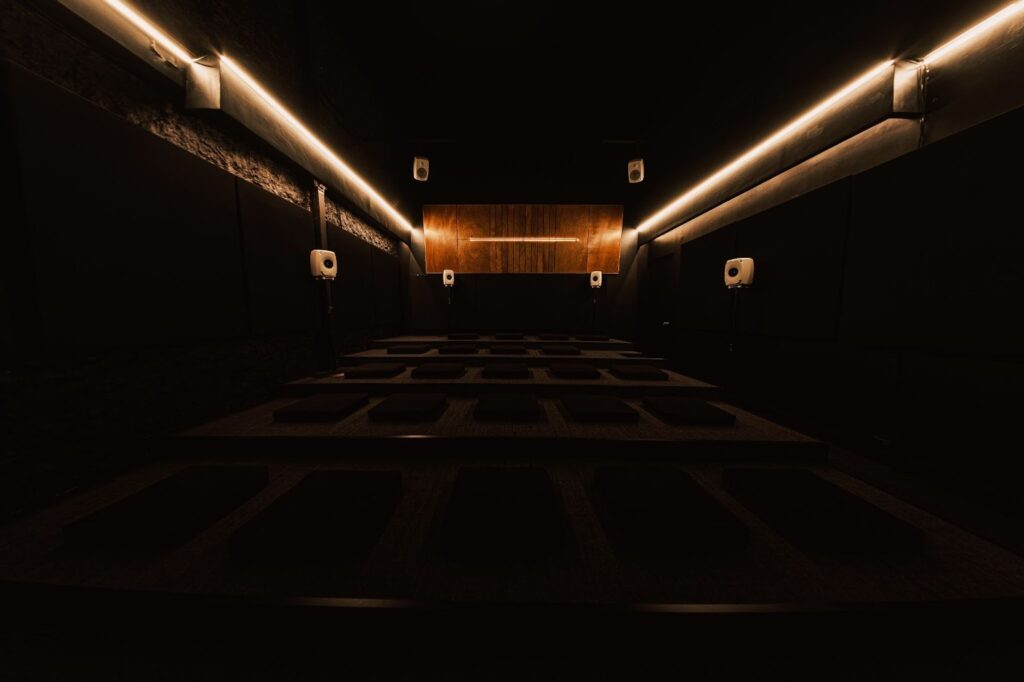
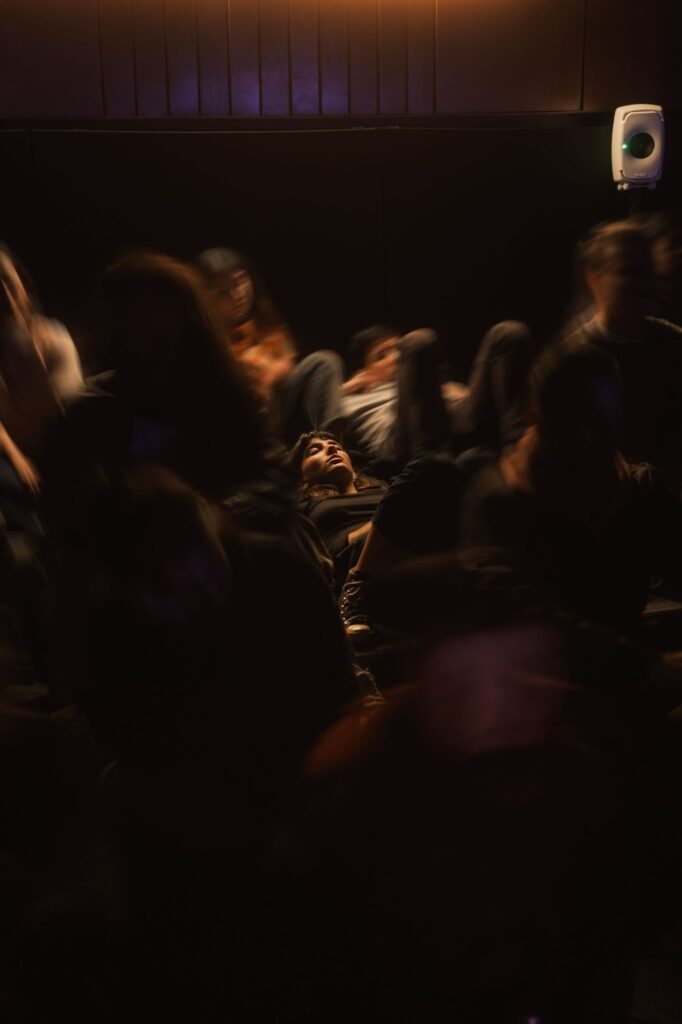
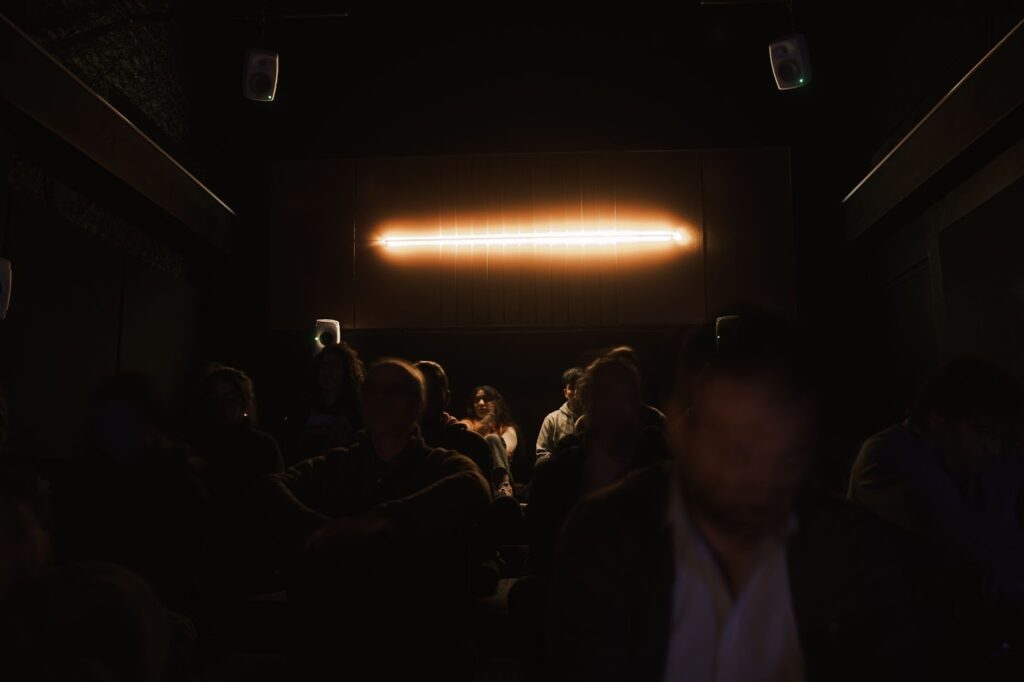
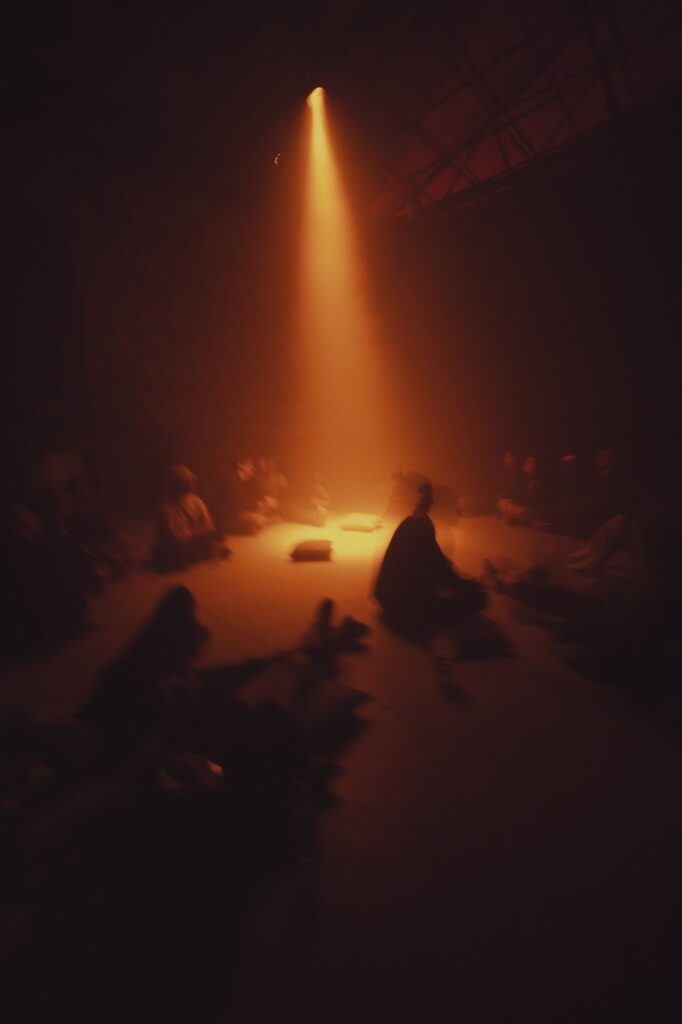
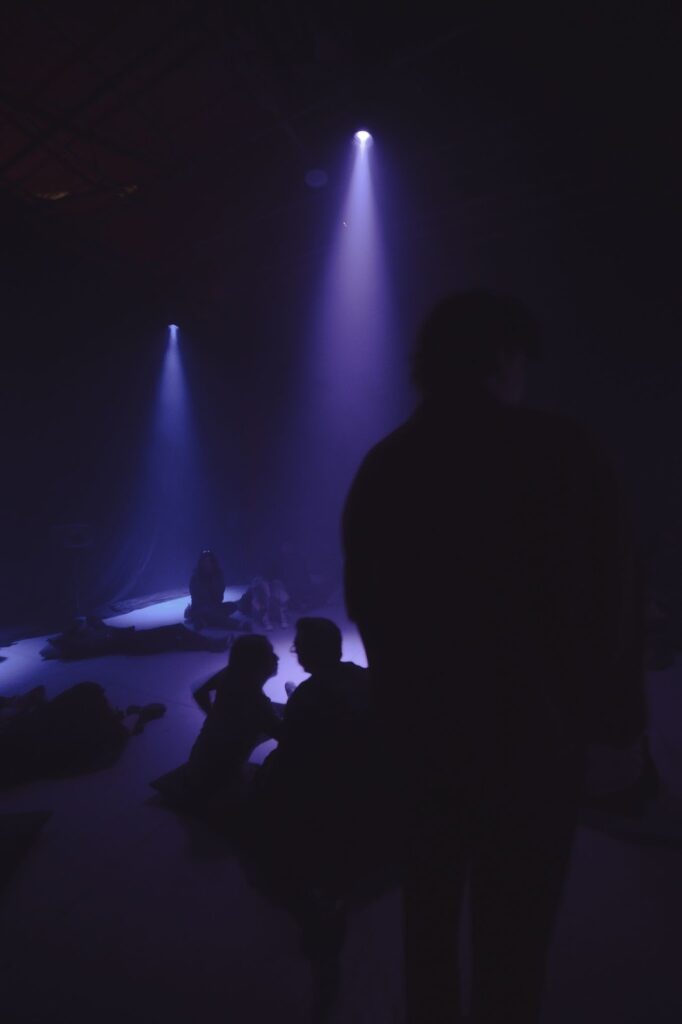
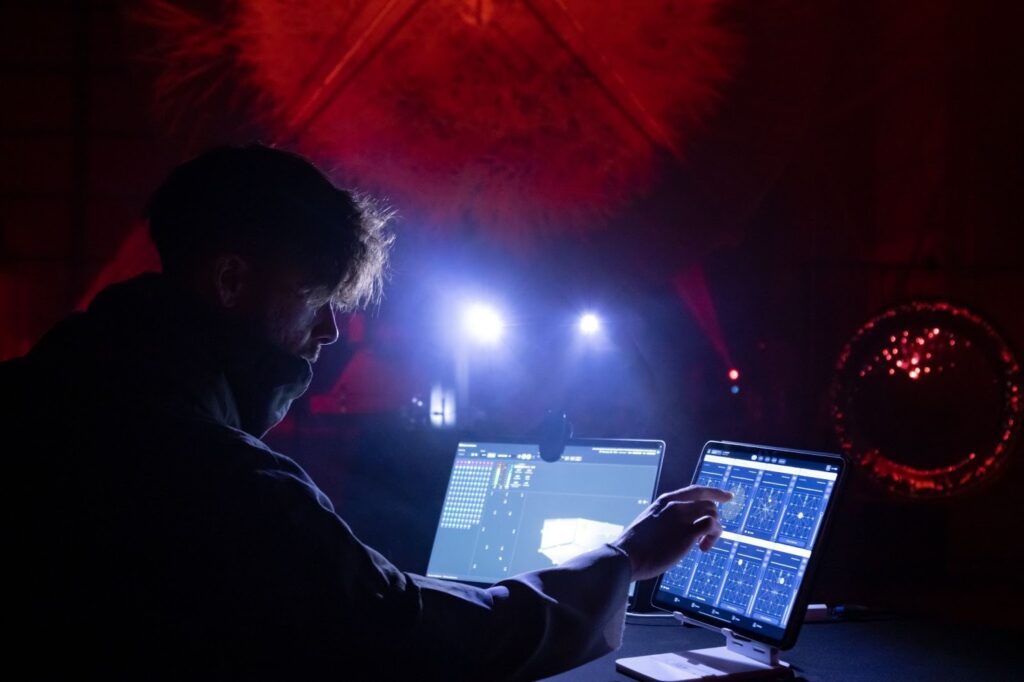
When we talk about sound architecture, we are talking about a hybrid practice: technical, perceptive, and poetic at the same time. A discipline where sound ceases to be an added layer to become a structural system, capable of defining limits, routes, tensions, and states of presence. This vision became especially tangible in our intervention at MUTEK MX, within the framework of its 20 years: an intersection between composition, space, and interaction with the audience.
Sound field as an instrument
Traditionally, audio has been treated as a contained phenomenon: speakers pointing towards an audience, a stage that emits, and an audience that receives. This logic is inherited from theater and the frontal concert, and also from stereo as a technical paradigm.
Immersive audio breaks that hierarchy.
Technically, we moved from a channel-based system to one based on objects and fields. We no longer speak only of left and right, but of three-dimensional coordinates: position, height, depth, trajectory, divergence. Sound ceases to be a line to become a volume.
A sound field is not the sum of speakers: it is the emergent result of multiple sources interacting with a real space. Early reflections, reverberant tails, diffraction, absorption, cancellations. All of that is no longer an “acoustic problem” that we try to eliminate, but an active part of the design. Architecture ceases to be neutral. It becomes an instrument and one more element of the narrative of the work.
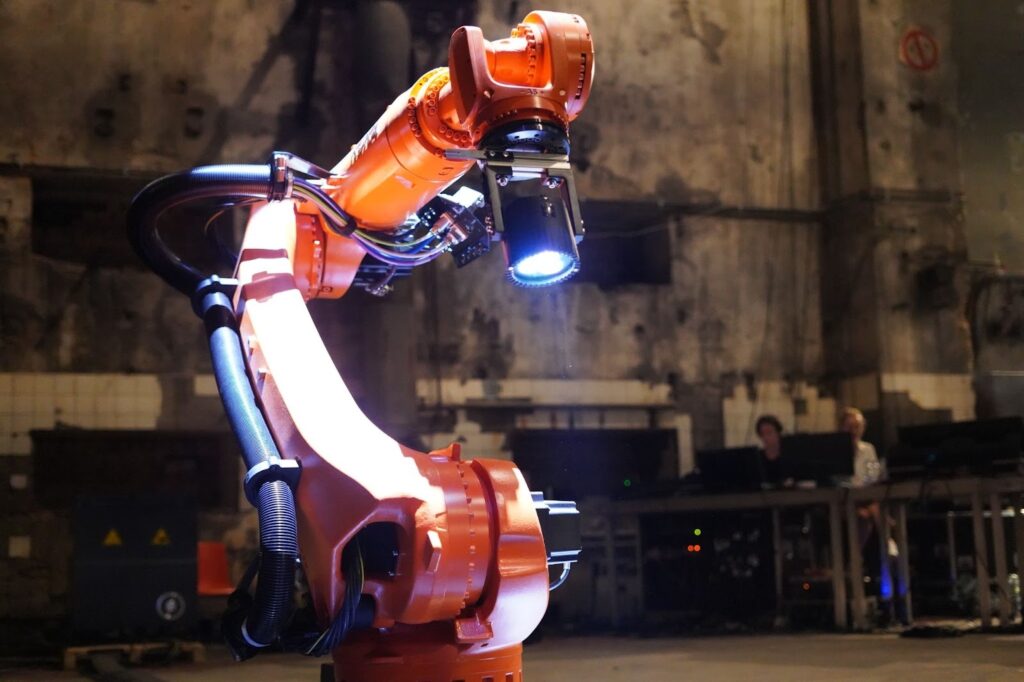
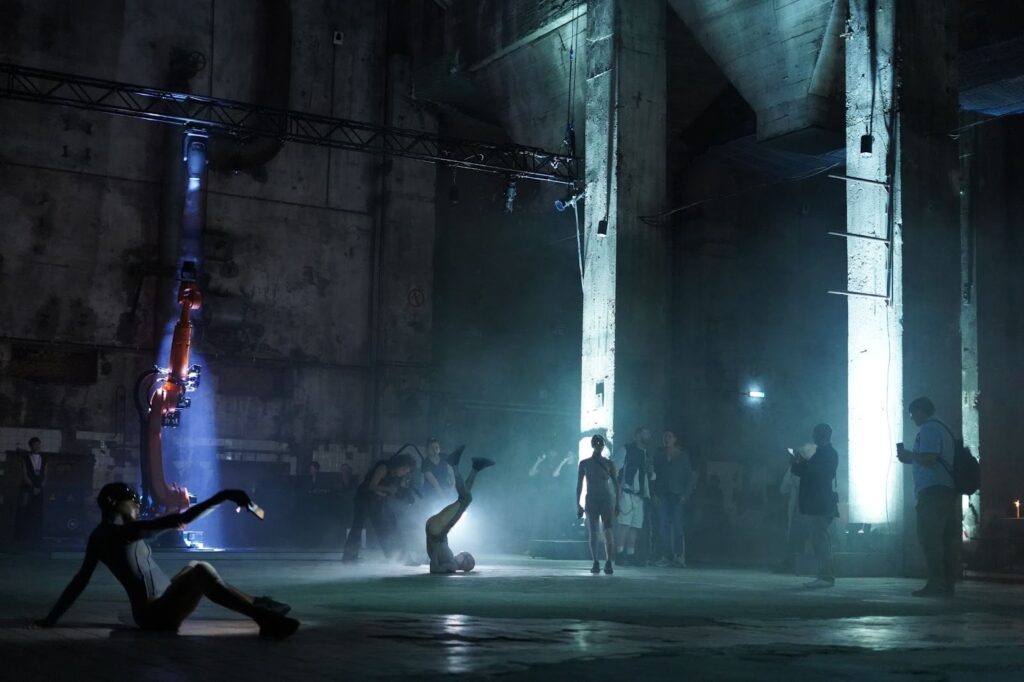
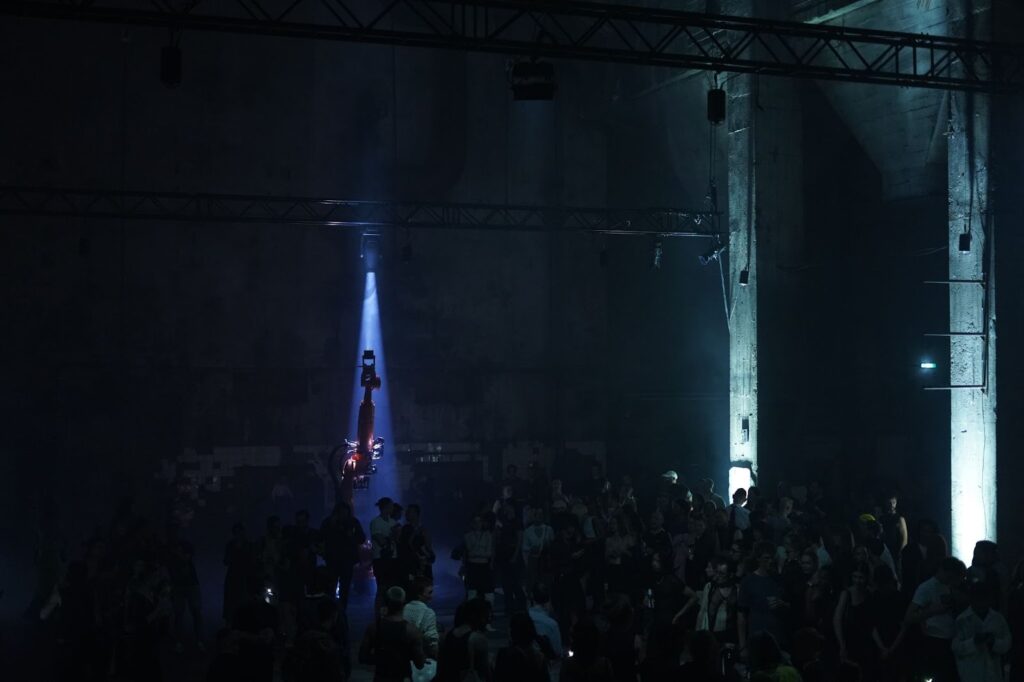
My first approaches to this occurred when I worked with Monom in Berlin. This studio works with 4DSOUND technology and a system of omnidirectional speakers. We carried out installations in unconventional places such as disused factories, royal palaces, and one that ultimately inspired me to investigate the acoustic phenomenon further. The “halle am Berghain,” which is a space attached to the famous Berlin techno club, used for art events, exhibitions, concerts, and installations, not for the club’s regular party, taking advantage of its unique industrial architecture for sound and visual experiences that fuse music, art, and technology. It is a place where the brutalist industrial atmosphere becomes an “acoustic organism,” offering a cultural experience different from that of the main dance floors.
At that time, we were working on the launch of a collection with Dasha Rush (composition) and Candela Capitan, who directed a dance troupe that interacted with the space, machines, music, and its spatial design.
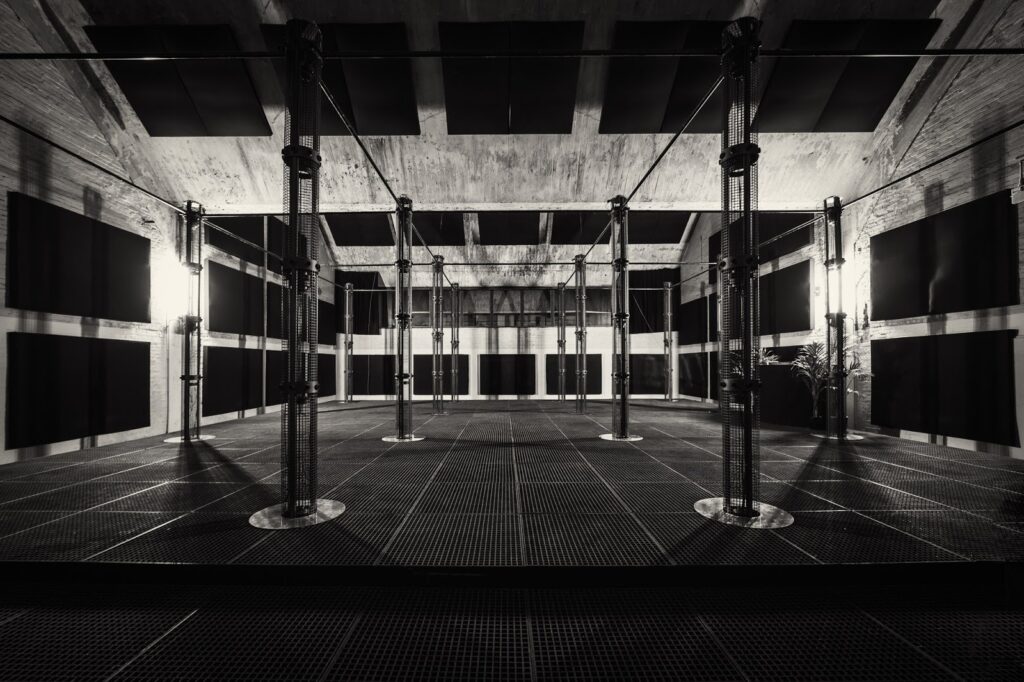
On that occasion, we installed a 60.12 system, 03 runs on the vertical axis of 20 speakers each, guarded by 12 subwoofers. The challenge was not minor since the “halle,” with its height and concrete walls, had around 8 seconds of decay.
We carried out a pre-production in the Monom studio, and upon arriving and reproducing the work, we realized that the natural reverb of this brutalist creature had a lot to tell us.
That’s how I realized that the interesting thing was not to start an acoustic battle with the space but to live with it and enhance the beauty of its resonant characteristics.
Worship Sound Spaces and sound as a ritual structure
The book Worship Sound Spaces has been one of the pillars of how I expanded my perspective on sound as matter. It raises an idea that resonates deeply with our practice: sound can organize the collective experience in the same way that sacred architecture does. Not as an ornament, but as a structure that guides attention, emotion, and behavior.
Places of worship cannot be understood solely from their visible form. Their true architecture unfolds in a simultaneously material and immaterial dimension, where sound plays a structural role in the experience of the place.
The book proposes that the construction and restoration of architectural heritage—especially in religious contexts—requires an interdisciplinary perspective. Architects, engineers, historians, acousticians, and anthropologists converge not only to preserve walls and their materials but to care for something much more fragile and complex: the sound atmosphere that has been shaped over centuries of rituals, uses, and collective practices.
From this perspective, sound is not an accessory phenomenon or an accidental consequence of the built space. It is an essential condition of its meaning. Churches, temples, and places of worship have historically been designed to house invisible presences, to amplify the voice, singing, silence, reverberation as sensitive manifestations of the transcendent. Sound, in these spaces, invokes. This principle makes me think about the theory of association that we have created to “the voice of God” and the divine as something extremely reverberant. Some sources say that this conception comes from when we were beings who lived in caves, and from there, this assumption is born. Anyway…
Here emerges a central idea that resonates deeply with our practice at Omni: sound spaces are complex systems where the physical and the symbolic coexist. Materials, surfaces, and volumes condition the sound, although it is the bodies, voices, and rituals that end up composing the soundscape. The space is activated through use, and sound is the mediator between architecture and experience.
Technical metaphors: sound as matter
Sound, as matter invisible to the eyes, has the particularity of affecting us in multiple ways. There are sounds that weigh, frequencies that sustain, layers that envelop, and silences that breathe.
But these metaphors are not only poetic: they describe real physical behaviors. Low frequencies occupy a volume that can cover kilometers of distance. High frequencies define limits, exalt emotions. Movement situates, generates orientation, reveals structures, rhythmic, harmonic, and melodic interactions. Silence allows the system and our mind to reconfigure.
Designing sound architecture is understanding these forces and organizing them in balance. It is accepting that sound, like architecture, are ways of understanding multiple realities.
Culture of listening
In a world saturated with visual and auditory stimuli, working with sound fields is an invitation to listen in another way: slower, deeper, more present. To understand sound as a shared experience, even in everyday contexts. The simplicity of listening becomes a radical act. Listening to music and sound in all its forms and colors. Listening to each other…
I sincerely believe that we could inhabit the present better. Many times, it is buried between the memories of the past and the expectations of a future that does not yet exist. Listening, like breathing, is an act of presence. It anchors us, orients us, situates us in the precise instant in which life is unfolding.
Cultivating listening also implies sharing silence, allowing emotions to express themselves without mediation, reconnecting us. It implies ceasing to constantly move—to procrastinate, to anticipate—and returning here. Relating to art in its multiple dimensions from simplicity, without always demanding stimulation, impact, or distraction.
It’s entertaining, yes, but not everything can or should be entertainment. We live in a moment of permanent overstimulation, a kind of collective gluttony to keep our dopamine levels at an artificially high point. Faced with that, deep listening appears as a countercultural gesture: a space of pause, regulation, and meaning. A place where sound does not push us forward but returns us to the center.
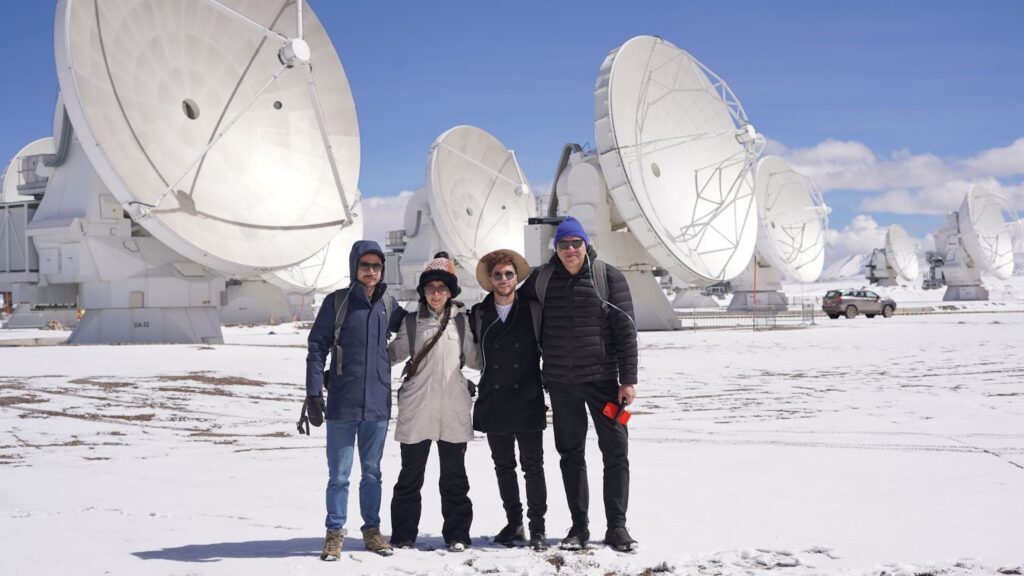
Historically, music and the arts have been much more than entertainment. They have been tools for reflection, social mobilization, and expansion of consciousness. They have allowed us to think about the world, question it, and also imagine other possibilities. Through art, we have tried to understand the universe. I remember when we made “Horizontes en Fuga” at the ALMA Observatory, which is the most powerful observatory that humanity has built to date as I write this. At the end of the work, one of the ALMA directors called me with a strong and stubborn voice: “Mr. Manhey! he exclaimed. Thank you for helping us understand what we investigate every day and every night in this place,” he told me with an effusive handshake.
Art has always been fundamental to projecting from a broader perspective the mathematical and physical formulas that we solve every day. There I understood how artists, in this case visual artists, have greatly helped to give visual and tangible form to those infinite scientific formulas on their blackboards.
We have found comfort, identity, and meaning, the invisible and the collective; Music has accompanied rituals, processes of mourning, celebrations, and has also been a driver of social transformation: it has amplified voices, sustained struggles, and demands for rights and dignity.
Not everything can—or should—be entertainment. Reducing music and the arts to an immediate consumption product is stripping them of one of their deepest functions. Perhaps it is time to put them back, as a society, in the place where they belong, not as background noise or as a constant distraction, but as essential practices to think about ourselves, listen to ourselves, and build a more conscious, sensitive present, and thus perhaps project a future.